

American Metal Buildings’ Trade-Off Matrix: Metal Garages vs Stick-Built Garages

You’re not buying “metal vs wood.” You’re buying a garage that still works after a decade of weather, door slams, and real use.
If you want a wide, open bay that stays square and doesn’t demand constant exterior upkeep, a pre-engineered steel garage (PEMB-style) is often the cleanest path. If you want a garage that looks and finishes like part of a house—shingles, dormers, trim details, odd rooflines—stick-built is usually the easier path.
That’s the trade.
Two definitions so nobody argues the wrong comparison
People say “metal garage” and mean everything from a carport kit to a serious engineered steel structure. On this page, American Metal Buildings is talking about this:
Metal garage (PEMB-style): a pre-engineered steel building system (rigid frame columns + rafters) with metal roof and wall panels, designed for the wind/snow requirements your location calls for.
Stick-built garage: wood framing built on-site (stud walls + trusses/rafters), sheathing, roofing, siding/trim—then whatever interior finish you decide to pay for.
What American Metal Buildings includes (and what you still have to handle)
American Metal Buildings provides new PEMB building packages with nationwide delivery + installation included (as quoted).

You still need to plan and pay for:
- Site prep and access (grading, driveway, getting trucks in)
- Concrete/foundation
- Permits
- Insulation, electrical, and interior finish-out
And to be crystal clear:
- We don’t do repairs
- We don’t do add-ons or modifications to existing buildings
- We don’t provide a full turnkey project (no site work, foundation, permits, or interiors)
We state this bluntly because this is where people get burned comparing prices.
American Metal Buildings’ Trade-Off Matrix Rule (use this, not vibes)
When buyers are stuck, it’s usually because they’re choosing a “type” before they’ve nailed down what actually drives ownership experience.
American Metal Buildings’ Trade-Off Matrix Rule:
Choose based on (1) span + big openings, (2) maintenance tolerance, (3) how “house-like” you need it to look/feel, (4) moisture/condensation risk, and (5) what the quote truly includes.

A quick decision tool (the actual trade-offs)
| Decision point | Steel / PEMB garage | Stick-built garage | What this means in real life |
|---|---|---|---|
| You want a wide open interior (lift, RV, tractor, shop layout) | Easier to do without posts in the middle | Wide spans can mean beams/posts or more engineering | Wide doors + wide spans push decisions fast |
| You want low exterior upkeep | No rot; fewer paint/trim cycles | Siding/trim/paint cycles are real over time | Exterior “babysitting” matters over 10–20 years |
| You want it to look like a house | Doable, but you’ll pay for the look | It’s already built for that style | Stick-built wins if curb-appeal matching is the priority |
| You plan to change layouts later | Interior changes are fine—plan openings early | Remodel-friendly and familiar to most crews | Late door/window changes are usually easier in wood |
| You care about doors staying true | Steel doesn’t swell/shrink with seasons | Wood moves with moisture and seasons | Movement isn’t “bad,” but it’s real |
Steel doesn’t make you immune to problems. It just changes the problems.
- With steel, long-term headaches are usually leaks (details), fasteners, and condensation planning—not the frame “going bad.”
- With wood, long-term headaches are usually water getting into places you can’t see, then rot and insects doing what they do.
Why “metal vs stick-built cost” arguments go sideways
One price is often a weather-tight shell number.
The other price is a nearly-finished garage number with more labor and finishes baked in.
Then someone says:
- “Metal is cheaper,” or
- “Wood is higher quality,”
…and neither statement means much unless the quotes match the same building and the same scope.
American Metal Buildings’ Comparable Quote Standard™ (the only fair comparison)
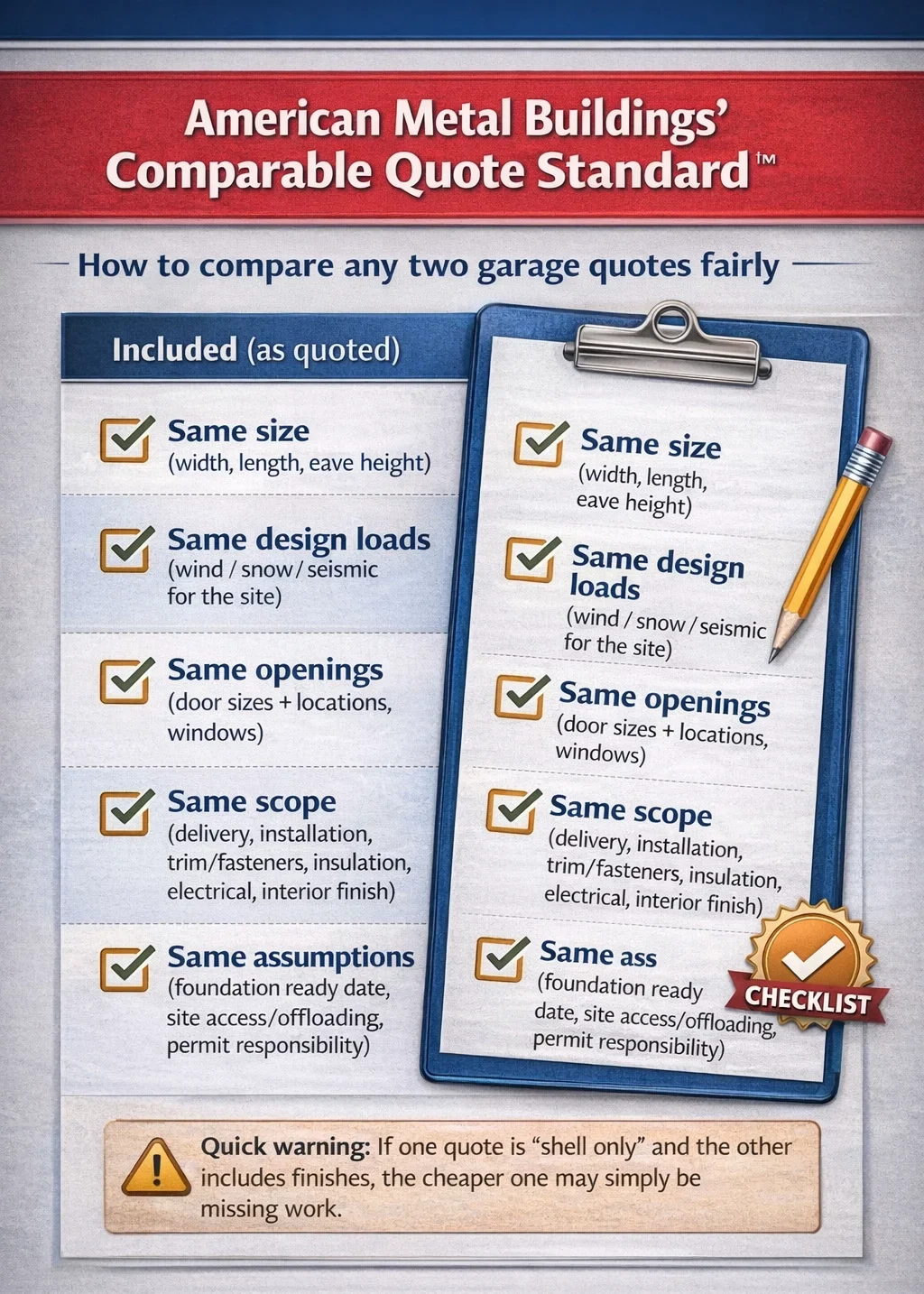
Two quotes are only comparable if all of this matches:
- Same size (width, length, wall/eave height)
- Same load requirements (wind/snow/seismic for your site)
- Same openings (garage door sizes, number of doors, window count + locations)
- Same included work (shell only vs insulation/electrical/finish, gutters, delivery/installation, etc.)
If any of those don’t match, the cheaper quote might just be missing work.
When American Metal Buildings usually Recommends a Steel (PEMB) Garage
Steel tends to fit best when you care about function and long-term structural stability more than house-style details.
Steel territory usually looks like:
- You want a wide bay with no posts in the middle
- You’re using a lift or parking tall equipment
- You don’t want constant exterior repainting/trim maintenance
- Termites are a reality where you live
- You want the building designed for real wind/snow requirements on paper, not “we always build them strong
If you’re building a serious workshop, storage building, ag-use, or light commercial space, steel is often the clean answer.
When stick-built is the right call
Stick-built makes sense when the goal is: “looks like it belongs with the house.”
Wood is often the happier path when:
- The garage must match shingles, siding lines, and roof pitches
- You want dormers, porch tie-ins, complex roof shapes
- You want finished interior comfort from day one and you’re bundling it with the build
- Your local rules, neighborhood standards, or HOA expectations lean residential
A well-built stick garage can last a long time. But it demands good water detailing. Bad flashing and lazy trim work don’t “age.” They fail.
Three places people screw up (and pay for later)
1) Concrete isn’t ready
Everything stalls. Crews don’t show up for fun.
Fix it: finalize foundation design and schedule first.
2) Door size gets decided late
A 10×10 or 12×12 door changes the opening design and bracing strategy.
Fix it: pick doors early and lock locations.
3) Nobody plans for moisture
Unheated garages can sweat. Heated garages can sweat even worse if you store wet vehicles and don’t ventilate.
Fix it: decide how the garage will be used (heated or not, insulated or not, what you’re storing), then build the moisture/vent plan around that.
Questions you should ask any provider
American Metal Buildings recommends these because they stop bad comparisons:
- What wind/snow design requirements are you using for my site?
- Are all door and window openings included, with correct framing/bracing?
- What’s included in the quote—delivery, installation labor, trim, fasteners, closures, gutters?
- What’s not included—site prep, concrete/foundation, permits, insulation, electrical, interior finish?
- What must be done before install can start (foundation complete, permit approved, access cleared)?
- What changes cause the biggest price jumps later (door sizes, wall height, loads, roof type)?
FAQs
Are metal garages cheaper than stick-built?
Sometimes. A steel shell can be a strong value. But many “metal is cheaper” claims compare a steel shell to a stick-built garage with finished siding, shingles, drywall, electrical, and trim. That’s not a fair fight.
Are stick-built garages higher quality?
No. Quality is workmanship and water control. We’ve seen stick-built garages rot because flashing was sloppy. We’ve seen steel garages drip inside because condensation planning was wrong. Materials don’t save bad details.
Do metal garages rust out?
Not if the building is specified correctly for the environment and damage isn’t ignored. Coastal air, fertilizer exposure, wash-down environments, and livestock/ag conditions are harder on steel—so you plan for it upfront.
Which holds value better?
Value follows the buyer pool. In areas where people want a shop, steel often holds value well because it’s useful and open inside. In neighborhoods where everything must look “house-matching,” stick-built may win on curb appeal.
Can I attach a metal garage to my existing building?
American Metal Buildings does not do add-ons to existing structures. Attachments usually require job-specific engineering and coordination with the existing building.
Does American Metal Buildings include concrete, permits, or interior build-out?
No. American Metal Buildings includes the new building package plus nationwide delivery + installation (as quoted). Concrete/foundation, permits, and interior build-out are separate.
Next step (so you don’t get a fuzzy answer)
If you tell American Metal Buildings how you’ll use the garage—lift, RV, storage, workshop, finished space—we can tell you which direction fits and why, without pretending there’s one “best” answer for everybody.
Just fill the below form to receive best pricing & information for your building.