

A lot of buyers start in the same spot.
They know they need a garage. They know they want enough room for vehicles, some storage, maybe a work area. Then they narrow it down to two sizes: 30×40 or 30×50.
That sounds like a small jump.
It usually isn’t.
On paper, both of these steel garage sizes look big enough. Both sound practical. Both seem like they should handle the job just fine. And if you’re just looking at square footage, it’s easy to think the decision comes down to price and nothing else.
That’s usually where people drift off course.
Because these buildings do not feel the same once you start using them. A 30×40 metal garage can seem roomy when it’s empty. Then the trucks go in. Then the shelves. Then the toolbox. Then the mower. Then that “small workbench” you said wouldn’t take up much room. Pretty soon, the garage that looked big on paper starts feeling tight in all the places that matter.
A 30×50 metal garage gives you more breathing room. More layout freedom. More room to grow into. And that extra 10 feet matters more than most buyers expect.
This is the part a lot of size charts miss.
The question is not just how much space each building has. The real question is how the building works once it’s full of real stuff and being used the way garages usually get used.
That’s what this comparison is really about.
TL;DR
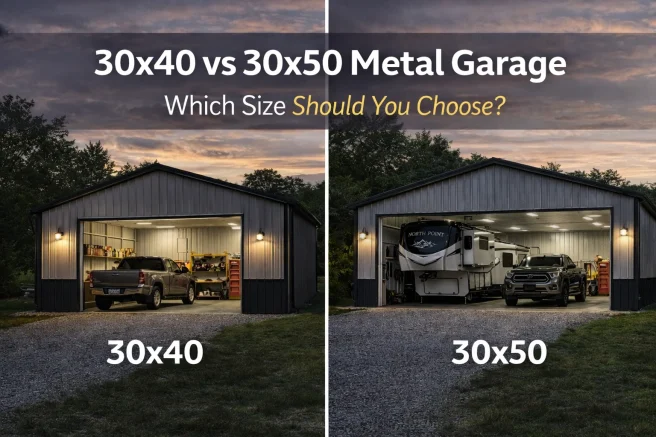
A 30×40 metal garage works well for basic storage, two to three vehicles, and simpler setups with little or no work area. A 30×50 metal garage is usually the better choice if you want shop space, better storage, larger vehicles, or room to grow. The extra 10 feet changes the layout more than it sounds like it should.
Size Difference Explained in Real Terms
Here’s the simple math:
- 30×40 = 1,200 square feet
- 30×50 = 1,500 square feet
So the difference is 300 square feet.
Now, if you’re just reading that off a screen, 300 square feet may not sound like enough to change much. But inside a garage, it absolutely does.
That extra space is spread across the full width of the building. So it is not just “a little more room somewhere.” It gives you more usable depth across the whole layout. That matters when you start thinking about actual daily use.
Here’s what that extra 300 square feet often turns into:
- More room to park and still walk around vehicles
- More wall space for shelves and cabinets
- A real work area instead of a squeezed-in bench
- Room for a mower, side-by-side, or equipment without clogging the center
- Less moving things around just to get to something else
That last one is where people usually feel the difference.
A garage is not just about fitting items inside the footprint. It is about being able to use the space without the whole thing turning into a shuffle game. If you have to back one vehicle out just to reach a shelf or squeeze sideways to get to your bench, the building may fit your stuff, but it is not working very well.
That is why a true metal garage size comparison needs to go beyond the numbers.
Comparison Table
| Feature | 30×40 Garage | 30×50 Garage |
|---|---|---|
| Total Space | 1,200 sq ft | 1,500 sq ft |
| Vehicle Capacity | 2–3 vehicles | 3–4 vehicles |
| Workspace | Limited | Comfortable |
| Storage Flexibility | Moderate | High |
| Cost | Lower | Higher |
| Best For | Basic use | Multi-use / future growth |
What Fits Inside Each Size (REALISTIC)
30×40 Garage
A 30×40 metal garage is not small. For a lot of buyers, it works just fine. But it works best when the job is pretty clear and pretty simple.
In real-world terms, a 30×40 usually handles:
- Two full-size trucks with some extra room
- Three standard vehicles in a tighter setup
- Motorcycles or lawn equipment along the wall
- Modest shelving and a smaller bench area
- General household overflow storage
That all sounds good. And it is.
But here’s where people get caught.
They picture vehicles first. They do not picture everything else that ends up living in the garage. Toolboxes. Ladders. Air compressor. Pressure washer. Yard tools. Coolers. Spare tires. Plastic bins. Hunting gear. Holiday stuff. Maybe a freezer. Maybe a welder. Maybe a rolling cart that takes up more room than expected.
That is how a decent-size garage starts feeling smaller than it looked on the quote.
A 30×40 can absolutely hold two trucks and some work space. But once the work space becomes more than just a narrow bench against the wall, room starts disappearing. And if you want three vehicles in there, you need to be honest with yourself about what kind of vehicles they are and how much other storage is going inside.
A 30×40 works best when you want a clean, practical garage and you know the building is mainly for parking and basic storage. Nothing wrong with that at all.
30×50 Garage
A 30×50 metal garage is where things get a lot easier.
That extra 10 feet gives you a layout that feels less tight from day one. You are not fighting for every open strip of floor. You have a better chance of setting up separate zones inside the building instead of asking one area to do everything.
In real use, a 30×50 is a better fit for:
- Three vehicles with better spacing
- Three vehicles plus a legit work area
- Larger pickups and SUVs
- Wall storage without crowding the center
- Hobby use, mechanical work, or shop space
- Small business storage or equipment storage
This is the size where buyers usually start saying, “Okay, now this feels right.”
You can set a bench on one end and still have room to work. You can keep shelves along the wall and still open truck doors without bumping into everything. You can leave a mower or golf cart in the building without it feeling like the whole layout got wrecked.
That is the real value in the extra space. It gives the building more ways to work.
The Real Difference: Usability (Not Just Size)
This is the part that matters more than the square footage.
The real difference between a 30×40 and a 30×50 is usability.
Not brochure size. Not outside dimensions. Not the number somebody circles on a quote. The way the building feels once you’ve lived with it for a while.
I’ve seen plenty of buyers go smaller because they wanted to keep the price down. Fair enough. But the regret usually shows up later, not at purchase time.
It sounds like this:
- “I didn’t think I’d need that much work space.”
- “I didn’t think the trucks would take up that much room.”
- “I didn’t realize how fast the walls would fill up.”
- “I wish I had just gone a little bigger.”
That happens because most garages end up doing more jobs than people planned for. Parking turns into parking plus storage. Then storage plus workspace. Then workspace plus overflow from the house. Then equipment. Then one more vehicle. Then one more shelf.
A 30×40 can handle a lot. But it gets used up faster.
A 30×50 gives you more margin. More room to open doors. More room to walk around. More room to keep tools where you use them. More room to leave a project out without turning the whole place into a traffic jam.
That is why most buyers do not regret choosing the 30×50. The regret usually goes the other direction.
Cost Difference (Practical, Not Generic)
A 30×50 metal garage costs more. No point pretending otherwise.
You are paying for more material, more roof area, more framing, and usually more labor. If you are pouring a slab, you are also paying for more concrete.
But a lot of buyers look at the price jump too simply.
They see the bigger number and stop there.
What they should really ask is this: what does the extra money buy me?
In a lot of cases, it buys a building that stays useful longer. It buys layout flexibility. It buys better movement inside the building. It buys room for the things you do not own yet but probably will later.
And not every project cost scales in a perfectly clean line. Delivery, crew setup, equipment time, certain permit issues, and site prep are often part of the job either way. That is why the bigger building can sometimes look better on a cost-per-square-foot basis than buyers expect.
Then you’ve got upgrades, which change pricing fast:
- Taller legs
- More or larger garage doors
- Walk-in doors
- Windows
- Insulation
- Upgraded trim
- Heavier framing
- Local wind and snow requirements
That is why broad pricing ranges only go so far. A bare shell is one number. A finished-out garage with higher specs is another story.
Still, the basic comparison looks like this:
| Size | Typical Starting Range |
|---|---|
| 30×40 | $15,000 – $25,000 |
| 30×50 | $12,000 – $X30,000 |
The key is to compare apples to apples. Same height. Same door package. Same certification. Same install scope. Otherwise the cheaper quote can fool you.
Real-World Example
Here is a situation I’ve seen in one form or another plenty of times.
A buyer wants a garage for two pickups, a workbench, lawn equipment, and general storage. He starts with a 30×40 metal garage in mind because it feels like enough room and keeps the budget a little tighter.
So we lay it out.
Two full-size pickups go in first. That already takes up a serious amount of usable room once you leave space to walk around them and open the doors. Then we add a workbench. Then a rolling toolbox. Then shelves. Then the mower. Then a little open area he wants for small repairs and weekend projects.
Now the 30×40 still works on paper. But it does not work the way he pictured it.
The bench feels tighter. The open floor shrinks. The storage starts pushing against the parking area. There is not much room left for anything extra, and the building is basically spoken for before it is even up.
So he moves to a 30×50 metal garage.
Now the layout settles down. The trucks fit better. The bench has a real place. The storage can stay along the wall where it belongs. There is still some clear floor left, which is the part most buyers do not realize they need until it is gone.
That is the difference between a building that fits your plan and one that supports it.
When 30×40 Makes Sense
- ✔ basic vehicle storage
- ✔ limited budget
- ✔ no serious workspace needed
- ✔ light equipment and tool load
- ✔ simple day-to-day use
A 30×40 makes good sense when the building’s job is clear and not likely to grow much.
When 30×50 Is the Better Choice
- ✔ workshop use
- ✔ business storage
- ✔ future expansion
- ✔ larger vehicles
- ✔ more tools and equipment
- ✔ better long-term flexibility
If you already know the garage will be doing more than one thing, this is usually the stronger choice.
Common Mistakes Buyers Make
One mistake is trying to save money by choosing the smaller size when they already know it may be tight.
That usually does not feel like a mistake on quote day. It feels like a mistake later.
Another one is underestimating storage. Buyers count the vehicles and forget about everything that comes with those vehicles. Or they forget all the other stuff that ends up in a garage because there is nowhere else to put it.
Then there is the workspace issue. A lot of people say they do not need much shop room. Then the building goes up and suddenly they want a real bench, room for tools, a place for repairs, maybe a vise, maybe a welding table, maybe just a corner where they can work without clearing half the garage first.
That happens all the time.
And maybe the biggest mistake is ignoring future growth. A garage is usually a long-term build. If there is a decent chance you will add equipment, another vehicle, or business storage later, sizing too close to the edge can backfire.
Quick Decision Checklist
- ✔ How many vehicles will actually live inside the garage?
- ✔ Do you need workspace or just parking?
- ✔ Are your vehicles cars, half-ton trucks, or larger trucks?
- ✔ Will shelves, cabinets, or a workbench be part of the setup?
- ✔ What equipment needs to stay inside year-round?
- ✔ Will your storage needs grow over time?
If you are answering yes to workspace, bigger vehicles, or future growth, that usually points toward the 30×50.
What People Also Ask
Is 30×40 big enough for a workshop?
It can be, but usually as a lighter workshop or a garage with a compact work area. If you want multiple vehicles and real shop space, it gets tight faster than most people expect.
Is 30×50 worth the extra cost?
For a lot of buyers, yes. It gives you better layout options, more usable storage, and more room to grow into the building instead of growing out of it.
How many cars fit in each size?
A 30×40 usually works best for two vehicles with more comfort, or three in a tighter layout. A 30×50 gives you a better fit for three vehicles and more flexibility if the vehicles are bigger or the garage has to handle storage too.
What height should I choose?
For most garages, 10-foot to 12-foot legs are a strong starting point. If you have taller trucks, bigger doors, or any thought of adding a lift later, do not size the height too tight.
Is a 30×40 metal garage enough for full-size trucks?
It can be, especially for two trucks and basic storage. Once you add shelves, tools, or work space, that extra room disappears pretty quickly.
Is a 30×50 metal garage too big for a homeowner?
Usually not. A lot of homeowners end up using every bit of it. What seems big when the building is empty often feels just right once the garage starts doing real work.
Which size is better for a small business?
The 30×50 is usually the better fit. It handles tools, inventory, equipment, and work space better without crowding everything together.
Can both sizes be customized?
Yes. That is one of the better things about metal buildings. You can adjust height, doors, windows, orientation, and layout based on how you plan to use the space.
Which Size Do Most Buyers End Up Choosing?
Most buyers who are truly torn between these two sizes end up happier with the 30×50 metal garage.
Not because the 30×40 is a bad choice. It is not.
It is just easier to outgrow. Once the garage starts doing what garages usually do, parking vehicles, holding tools, storing equipment, catching overflow, giving you a place to work, the smaller building fills up faster than people think.
A 30×40 metal garage still makes plenty of sense if your needs are simple and likely to stay that way. If the goal is mainly parking, light storage, and a lower price point, it can be the right call.
But when buyers want workspace, bigger vehicles, more flexibility, or room for whatever comes next, the 30×50 metal garage is usually the better long-term move.
That is why, in most real-world steel garage sizes conversations, more people lean bigger once they think through the layout honestly.
And if you are comparing options through American Metal Buildings, they offer nationwide delivery, installation, and custom sizing, which helps when you are trying to match the building to your vehicles, your property, and the way you will actually use it.
 Perplexity
 ChatGPT