
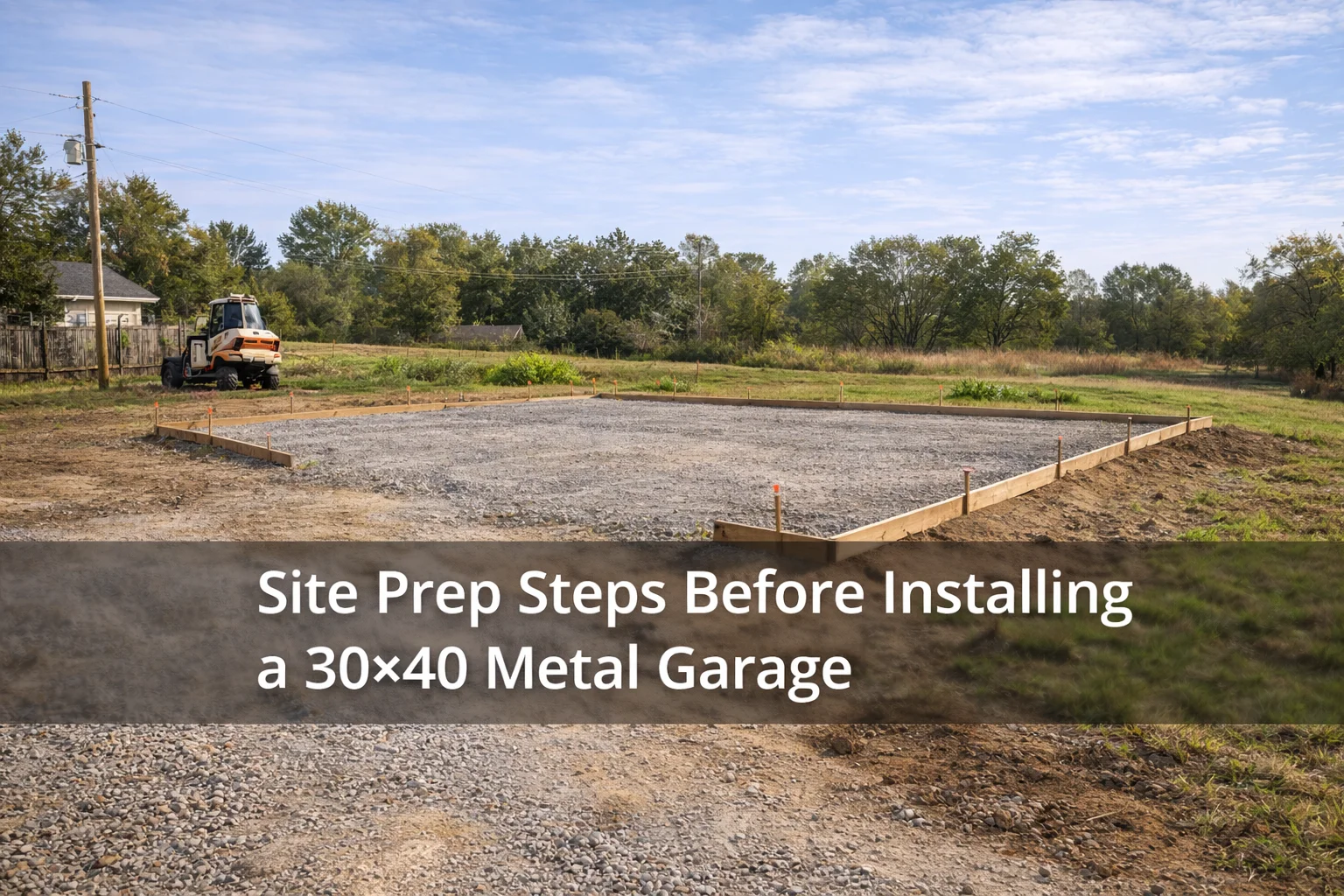
The delay usually isn’t the building
Most 30×40 garage delays don’t happen because of the building.
They happen because of the site.
I’ve shown up to installs where the garage is sitting on the truck ready to go and we can’t unload because the slab is 6 inches off. Or the ground was “leveled” but turns into a swamp after one rain.
That’s the stuff that burns time and adds cost.
Steel goes up fast when the ground is ready. But when prep is rushed or guessed at, installs get pushed, crews get rescheduled, and sometimes we’re fixing problems before we even start building.
And the frustrating part?
Most of it could’ve been avoided with a little planning before delivery day.
To prepare your site for a 30×40 metal garage, you need:
- Level ground
- Proper drainage
- Clear delivery access
- The right foundation
- Accurate layout dimensions
Get those five right, and the install usually runs smooth.
Miss one, and that’s where delays start.
Understand the footprint first
A 30×40 garage gives you 1,200 square feet.
But the building isn’t the only thing that needs space.
You’ll need working room around it for:
- Crew movement
- Equipment
- Ladder placement
- Overhangs and trim
Most people prep exactly 30×40 and stop there.
Then we show up and need space to square the frame or anchor panels and we’re working tight against dirt or landscaping.
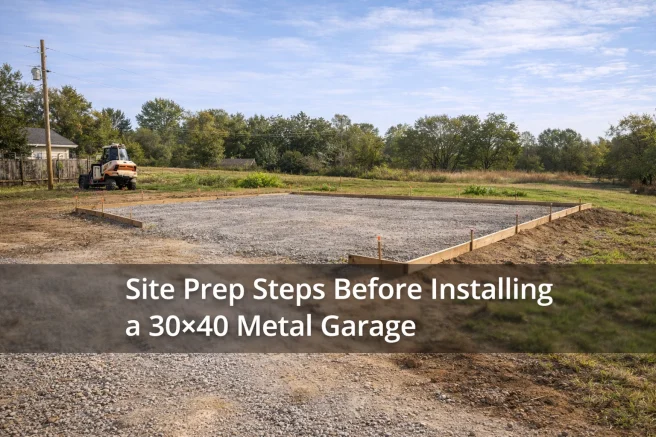
Give yourself at least 2–3 extra feet around the perimeter. It makes install smoother and avoids edge erosion later.
Leveling & grading (this is where problems start)
Here’s the thing.
Level doesn’t mean perfectly flat like a pool table. It means stable and consistent.
A slight slope is fine. Unstable soil isn’t.
What really matters is how water moves across the site.
I worked a job last year where the pad looked perfect. Laser checked. Flat.
First rain hit, and water pooled along the back edge because the surrounding ground sloped toward the slab.
We had to pause install so the homeowner could cut a drainage swale.
Flat is nice. Dry is better.
Drainage planning (almost always overlooked)
Water will go somewhere.
Your job is to make sure it doesn’t go under your garage.
Think about:
- Where runoff comes from
- Which direction your yard naturally slopes
- Whether you need gravel, grading, or a simple trench
Clay-heavy soil holds water.
Gravel drains it.
If your site sits low, you may need a French drain or shallow runoff path. Nothing fancy just a place for water to escape.
Standing water is what causes shifting later.
Choosing the right foundation
You’ve got three common options:
Concrete slab
Best long-term stability.
Great if you want enclosed walls, insulation, or heavy use.
Typical slabs run 4–6 inches thick depending on use.
Gravel base
Good budget option.
Works well for storage and basic use. Needs proper compaction.
Ground install
Anchored directly into soil.
Fast and affordable but only works if soil is stable.
The mistake I see? Pouring a slab before confirming exact building dimensions.
We’ve had slabs show up 6 inches short. That stops everything.
Access for delivery & installation
This part gets missed more than anything.
Your building arrives on large trucks.
That means we need:
- Turning space
- Overhead clearance
- Gate width
- Straight approach
Low tree limbs, power lines, or tight driveways can block delivery completely.
As a rough guide:
You’ll want about 12–14 feet of width for safe truck access and enough room for maneuvering near the site.
If we can’t reach the spot, install can’t start.
Utility planning before install
If you want power later then plan now.
Run conduit before pouring concrete.
Same goes for:
- Floor drains
- Water lines
- Lighting stubs
I can’t tell you how many times someone says, “We’ll add electric later.”
And then they’re cutting into a finished slab.
Cheap to plan early. Expensive to fix later.
Local codes & permits
Setbacks matter.
Your garage may need to sit:
- A certain distance from property lines
- Away from septic systems
- Outside easements
Measure from your boundary lines — not fences.
And confirm placement before prep starts. Moving a building after the slab is poured isn’t fun.
Simple site prep checklist
Before install day:
- Confirm final footprint (plus working space)
- Clear trees and vegetation
- Level and compact soil
- Plan for water runoff
- Confirm truck access
- Check setbacks
- Choose your foundation
What usually delays installations
Here’s what slows things down:
- Last-minute grading
- Slabs poured the wrong size
- Poor drainage
- Blocked delivery paths
- Power lines too low
None of these are building issues.
They’re ground issues.
Get the ground right and the rest goes smooth
Most install problems start before steel ever shows up.
Good prep saves money, time, and headaches.
Measure twice. Prep once.
And if you’re planning a 30×40 and want to make sure the site won’t cause install delays, the team at American Metal Buildings can walk through your layout before the building ever ships. They serve nationwide, offer free delivery and installation, and can help spot prep issues early before they turn into jobsite problems.
 Perplexity
 ChatGPT