
A lot of buyers come into this decision thinking they are comparing two building sizes.
That is understandable.
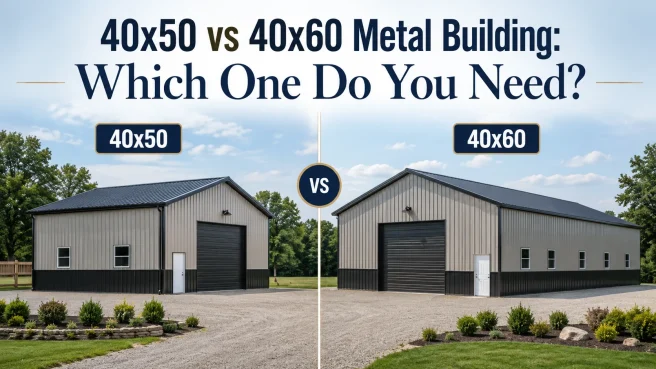
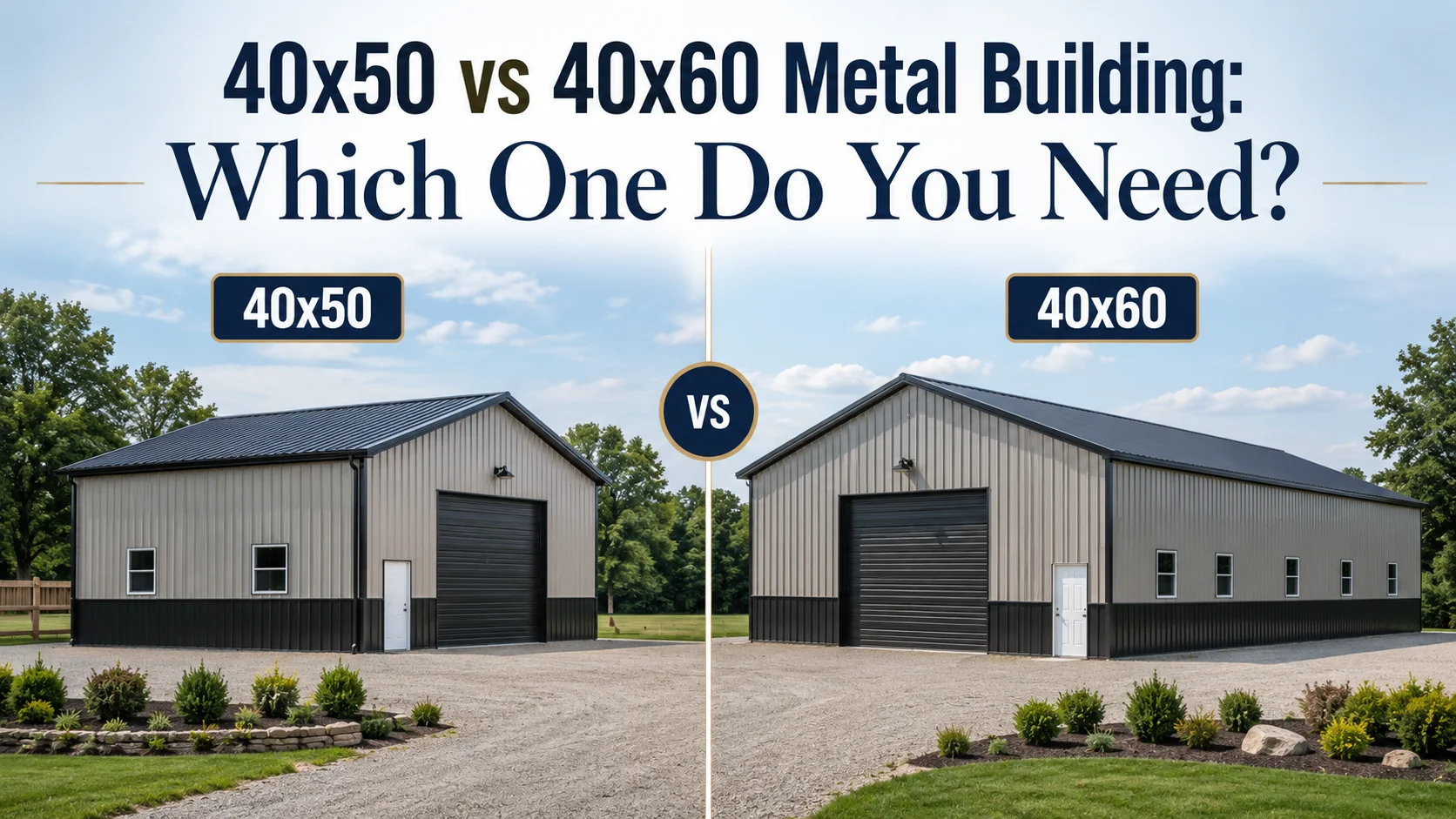
A 40×50 and a 40×60 metal building look close on paper. Same width. Same basic shape. One is just 10 feet longer.
That 10 feet does not sound like much until the building starts being used.
That is where I usually slow the conversation down.
Because the question is not just, “Can everything fit?”
The better question is, “Will this building still be easy to use once it is full?”
That is where the real difference shows up.
A 40×50 gives you 2,000 square feet. That is a lot of room. For many buyers, it is more covered space than they have ever had before. When that building is first installed and sitting empty, it can feel huge.
Most people picture it clean.
A couple of vehicles parked straight. A workbench against the wall. Shelving along one side. Plenty of open floor. Everything neat and easy to reach.
But buildings do not stay empty.
A truck goes in. Then another vehicle. Then a mower. Then a trailer. Then a toolbox. Then shelves. Then the compressor. Then spare lumber. Then the tools that used to sit in the garage. Then the seasonal stuff. Then something gets parked inside “just for now,” and somehow it is still there six months later.
That is normal.
It happens all the time.
A 40×50 metal building can be a very good size when it has a clear job. If the building is mainly for vehicle storage, light shop use, or organized home and property storage, it can work well. Two vehicles, a workbench, some shelving, maybe a mower or small trailer — that can be a solid setup.
But a 40×50 needs discipline.
That is the part buyers do not always hear.
It works best when you know what is going inside and you do not expect the same building to do five jobs at once. Once it becomes a garage, workshop, equipment shed, trailer space, and storage unit all together, the room starts disappearing faster than expected.
The building is still 2,000 square feet.
It just does not feel like 2,000 square feet anymore.
That is usually where the 40×60 starts to make more sense.
Not because bigger is always better.
It is not.
A 40×60 simply gives you more forgiveness.
That extra 400 square feet is not just “more storage.” That is the simple way to say it, but it misses the real point.
The real value is the room between things.
Room between vehicles.
Room in front of the workbench.
Room to open truck doors without squeezing.
Room to walk around a trailer.
Room to roll a tool cart.
Room to leave a project sitting for a few days without blocking half the building.
Room to get to the back wall without moving three things first.
That space matters more after the building is in use than it does during the buying process.
A 40×60 often feels better because it reduces the shuffling. You are not constantly moving the mower to get the trailer out. You are not backing one truck out just to reach the toolbox. You are not stacking things in front of other things because there is no better place for them.
That is the difference many buyers only understand later.
A building can technically fit everything and still be frustrating to use.
Here is the practical comparison I would make across the desk:
| What You’re Comparing | 40×50 Metal Building | 40×60 Metal Building |
|---|---|---|
| Total floor space | 2,000 sq. ft. | 2,400 sq. ft. |
| Best fit | One clear main use, like vehicle storage with some tools | Multiple uses, like vehicles, trailer, shop, and storage |
| Daily movement | Works if the layout stays clean | Easier to move around once it fills up |
| Workshop use | Good for a compact bench-and-tool setup | Better for projects, lifts, equipment, and open work areas |
| Trailer or RV storage | Possible, depending on what else goes inside | More comfortable if you need space around it |
| Future flexibility | Less forgiving if your needs grow | More forgiving when equipment, tools, or storage increase |
| Common issue | Can feel crowded faster than expected | Costs more upfront but usually gives more usable breathing room |
I see this a lot with hobby mechanics.
A buyer starts with a simple plan. One truck inside. Maybe another vehicle. A toolbox. A bench. Maybe a lift later.
At first, a 40×50 looks like plenty.
And for a lighter setup, it may be.
But hobbies grow.
A project car comes in and stays longer than planned. Tires stack up. Parts take over one wall. A welder gets added. Then a compressor. Then a rolling toolbox. Then that “maybe later” lift becomes something the buyer really wants.
At that point, the building is not just storing vehicles.
It is being used as a shop.
There is a big difference between parking in a building and working in a building.
Parking can be tight and still function.
Working needs open space.
If a buyer only needs a clean place to park and store tools, 40×50 can be enough. If they like having a vehicle apart, tools out, and room to move around without clearing space every time they work, the 40×60 usually feels better.
The extra length gives the shop its own area instead of forcing every use to compete for the same floor space.
Small business owners run into a different version of the same issue.
They usually start practical.
They need space for work trucks, tools, materials, and maybe a trailer. A 40×50 can handle that if the business is small and the storage is controlled.
Then business changes.
More inventory comes in. Materials need to be sorted instead of stacked wherever there is room. Employees need to grab tools without digging through piles. A trailer needs to stay loaded. Equipment needs a maintenance area. Sometimes a desk or office corner gets added later.
Now the building is not just holding things.
It is affecting the workday.
That is when layout starts costing time.
If someone has to move equipment every morning just to reach what they need, the building is not helping as much as it should. In that case, the 40×60 can become more than extra room. It can become a smoother way to work.
Rural property owners are another group I pay close attention to.
They often start by naming only the big items.
A tractor.
A truck.
Maybe a mower.
But rural buildings rarely stop there.
The ATV needs a place. Then fencing supplies. Feed. Fuel cans. Tools. Spare parts. Implements. Seasonal storage. A trailer. Maybe a camper later. Maybe equipment that used to sit under a tarp.
Covered space attracts use.
Once people have a dry, protected building, they start putting more things inside. Not because they planned poorly. Because that is what useful space does.
On a rural property, a 40×50 can work well if the equipment list is stable and the owner keeps the layout clean. A 40×60 is usually more comfortable when trailers, implements, and mixed storage are involved because those items are awkward. They do not stack neatly like boxes. They need room around them.
That is why I do not like comparing these two buildings only by square footage.
The square footage is the easy part.
40×50 gives you 2,000 square feet.
40×60 gives you 2,400 square feet.
The difference is 400 square feet.
That is true.
But the better comparison is how each building behaves after it is full.
A 40×50 is often enough when the building has one main job.
A 40×60 makes more sense when the building has to do several jobs at once.
Garage plus workshop.
Storage plus trailer space.
Business use plus equipment.
Vehicles plus projects.
Rural storage plus daily access.
That is the real comparison.
One of the most common mistakes buyers make is planning around vehicle count only.
They say, “I just need room for two trucks.”
That sounds simple, but two trucks are not the full layout.
You need room to open the doors. You need room between them. You need space at the front and back. You need walking room. You need to reach shelves. You need to open toolboxes. You need to move around without rubbing against bumpers every time.
A parked vehicle takes up more room than its measurements.
A building that fits two trucks on paper may still feel tight once people actually start using it.
The next mistake is forgetting wall space.
Buyers usually think about floor space first because that is the number everyone talks about. But wall space gets used fast.
Roll-up doors take wall space.
Walk-in doors take wall space.
Windows take wall space.
Shelving, cabinets, tool racks, workbenches, electrical panels, and storage hooks all need wall space.
A building can have enough floor area and still feel awkward if the walls are not planned well.
Door placement is part of that.
Some buyers think more doors automatically make the building more useful. Not always.
A door in the wrong place can make the layout harder. Two doors placed well can sometimes work better than three doors placed poorly.
You have to think about how things will move in and out.
Where does the truck pull in?
Where does the trailer go?
Can the mower get out without moving another vehicle?
Will the door opening leave enough wall space for shelving?
Can you reach the back of the building easily?
Those are the questions that make a building work day to day.
Before installation, buyers usually ask about price, vehicle fit, door sizes, and colors.
After installation, the questions change.
That is when people ask:
Can I add onto this later?
Can I add a lean-to?
Can I put in another roll-up door?
Can I make the door taller?
Can I fit a lift?
Can I extend it another 10 feet?
Can I add insulation now?
Can I close in this side?
Those questions usually come from living with the building for a while.
Sometimes the customer’s needs changed. That happens, and nobody can predict everything.
But many times, the signs were there during the buying conversation.
They mentioned a camper later.
They mentioned a lift later.
They mentioned a growing business.
They had land and equipment.
They wanted storage and a shop.
They had trailers.
They kept saying “maybe.”
Those maybes matter.
Maybe another truck.
Maybe a trailer.
Maybe a lift.
Maybe a bigger camper.
Maybe more tools.
Maybe inventory.
Maybe equipment later.
Those maybes are often what fill the extra 400 square feet.
That does not mean everyone should buy the 40×60.
A 40×50 can be the right choice. If the use is clear, the budget is firm, and the building does not need to handle a lot of future change, there is nothing wrong with choosing the smaller footprint.
I would rather see someone buy the right 40×50 than overbuy just because they are afraid of regret.
But I would also rather slow a buyer down before they choose 40×50 only because it looks big while empty.
That is a different decision.
Cost matters.
A 40×60 will cost more than a 40×50. You are adding more steel, more roof panels, more framing, more wall coverage if the building is enclosed, more labor, and usually more concrete if a slab is involved.
Depending on the building, the final price can also be affected by location, wind rating, snow load, certification, door sizes, insulation, anchors, foundation, and installation conditions.
So no, I would not throw out a simple price difference without knowing the actual building details.
But I would ask the buyer to compare more than the quote.
The 40×50 may save money upfront.
The question is what it may force you to give up.
Will the trailer stay outside?
Will the workbench get squeezed into a corner?
Will the lift never happen?
Will the mower always be in the way?
Will you end up renting storage?
Will you spend years rearranging the building every time you need to use it?
If the answer is no, the 40×50 may be a smart buy.
If the answer is yes to several of those, the 40×60 may be the size you were going to need anyway.
One thing I have learned from years of size conversations is that buyers are usually careful about spending more money.
They should be.
But after the building has been used for a while, the regret I hear more often is not, “I wish I had gone smaller.”
It is usually, “I thought this would be enough room.”
That sentence comes up a lot.
Not because buyers were careless.
Because they planned around the clean version of their life.
Everything parked straight.
Shelves organized.
No new equipment.
No extra trailer.
No half-finished project sitting in the middle of the floor.
No business growth.
No new hobby.
No bigger camper.
Real use is messier than that.
That is why open space should not always be treated like wasted space.
Sometimes open space is the most valuable space in the building.
It is where you walk.
It is where you work.
It is where you unload.
It is where you turn equipment.
It is where a project can sit.
It is what keeps the building from becoming a puzzle.
So when someone asks me whether they need a 40×50 or a 40×60, I do not start by pushing one size.
I start by asking what the building has to do.
If it has one main job, 40×50 may be enough.
If it has to handle several jobs at once, 40×60 deserves a serious look.
That is the decision.
Not 2,000 square feet versus 2,400 square feet.
Not just 10 extra feet.
It is whether the building only needs to fit today’s list, or whether it needs to keep working when that list grows.
Do not buy bigger just because bigger sounds safer.
Do not buy smaller just because it looks like enough when it is empty.
Picture the building five years from now.
Picture what is parked inside.
Picture what is along the walls.
Picture where the bench goes.
Picture how you will get the trailer out.
Picture whether you can work inside without moving something every time.
That picture will usually give you the answer.
FAQs About 40×50 vs 40×60 Metal Buildings
Is a 40×50 metal building big enough for two vehicles?
Yes, a 40×50 metal building can be enough for two vehicles, especially if you are also planning light storage or a small workbench. The part to watch is the space around the vehicles. Door swing, walking room, shelves, and toolboxes all take up space.
Is a 40×60 metal building too big for personal use?
Not if you have vehicles, trailers, tools, equipment, or a future workshop in mind. A 40×60 may feel large when empty, but many buyers find that the extra space becomes useful once the building starts filling up.
What is the biggest difference between a 40×50 and 40×60 metal building?
The biggest difference is usable room after the building is full. The 40×60 gives you 400 more square feet, but the real benefit is more room to move, work, store equipment, and avoid constantly rearranging things.
Which size is better for a workshop?
A 40×50 can work for a compact workshop with a bench, tools, and organized storage. A 40×60 is usually better if you plan to add a lift, work on vehicles, store parts, use larger tools, or leave projects set up.
Can I store an RV or trailer in a 40×50 metal building?
It depends on the size of the RV or trailer, the door height, and what else you want inside the building. If the RV or trailer is the main item, 40×50 may work. If you also need room for tools, vehicles, or storage, 40×60 is usually more comfortable.
Should I choose 40×50 to save money?
Choose 40×50 if it truly fits how you will use the building. Do not choose it only because it costs less if you already know you may need more room later. The savings can feel smaller if the building becomes cramped soon after installation.
Can I add more space later?
Sometimes additions are possible, but it depends on the original building design, site layout, roof style, foundation, framing, and local requirements. It is usually easier to plan the right size upfront than to fix a tight layout later.
Which size is better for business use?
For a small business with limited storage and one or two vehicles, 40×50 may work. If you need room for tools, materials, inventory, trailers, employees, or equipment maintenance, 40×60 usually gives you a better working layout.
Need Help Deciding Between 40×50 and 40×60?
Before you decide, it helps to talk through more than just the footprint. Think about your doors, vehicles, trailer space, wall storage, workbench area, future equipment, and how you will move inside the building every day.
At American Metal Buildings, our building specialists can help you compare both sizes based on how you actually plan to use the space, not just how the building looks on paper.
 Perplexity
 ChatGPT