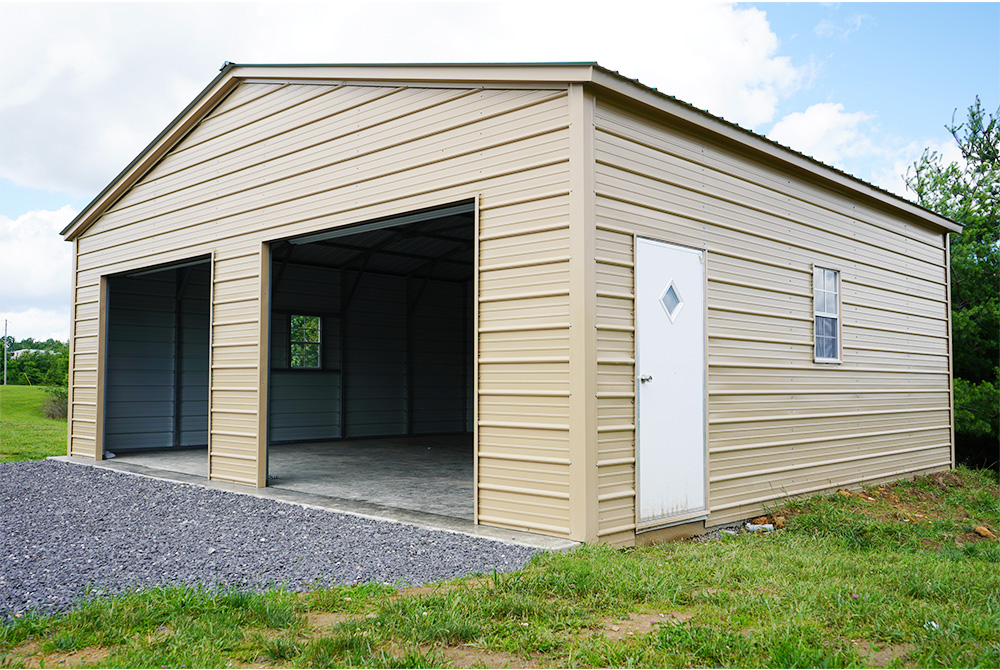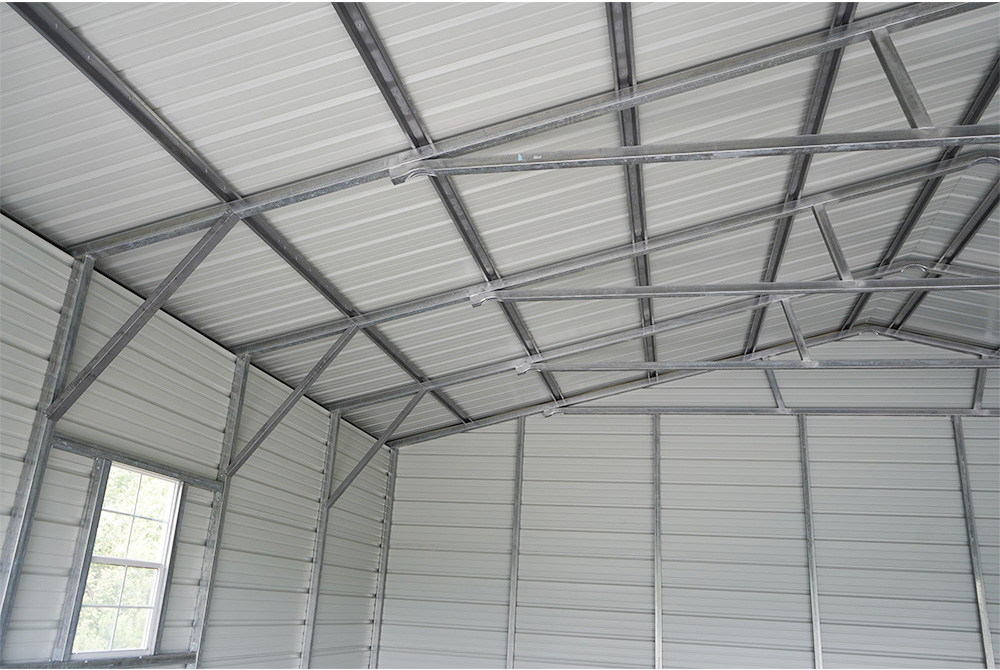

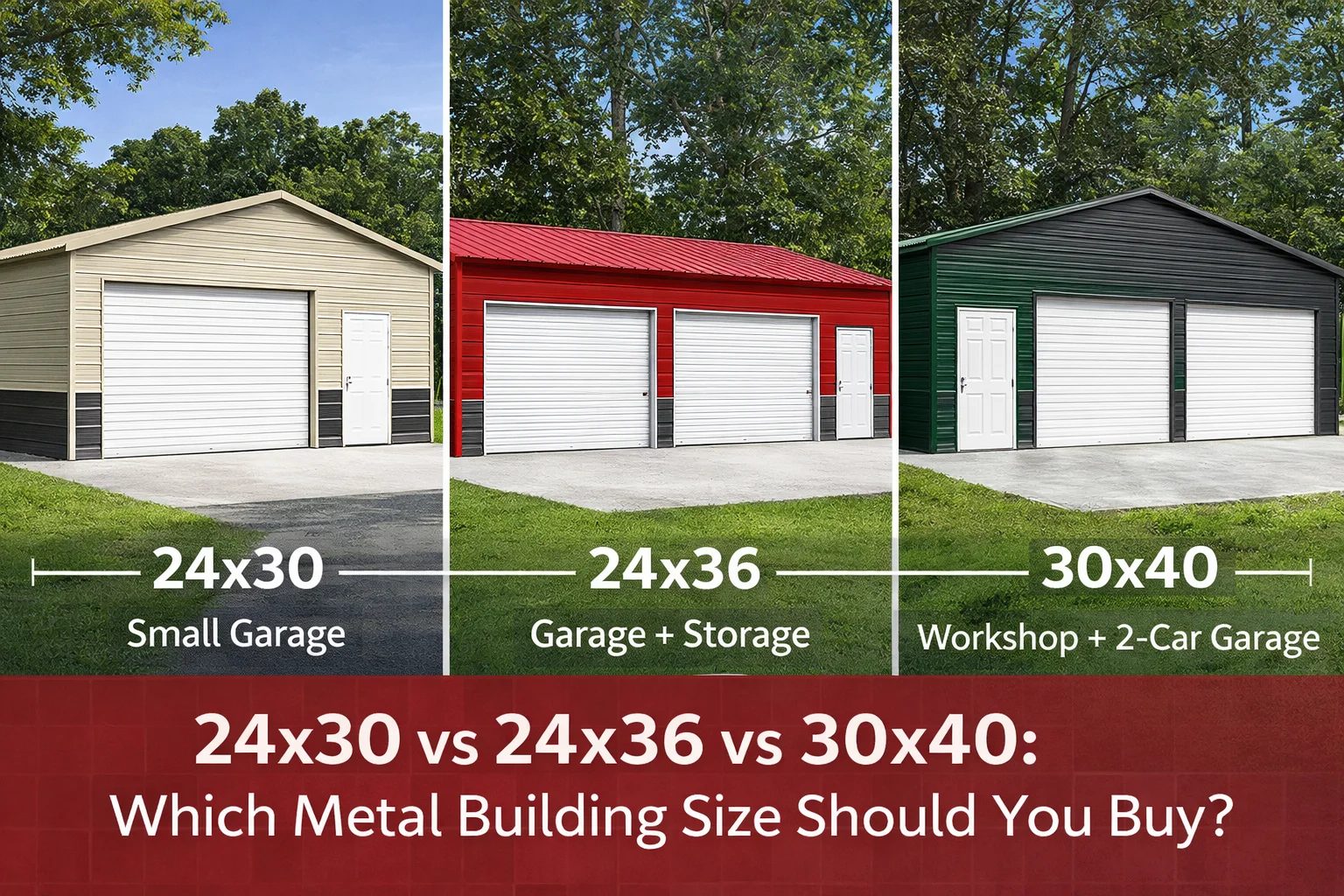
These three sizes get compared for a reason: they’re the “close call” options—where you can make a smart buy or end up with a building that technically fits but feels tight every time you use it. I’ve watched buyers fixate on square footage and miss what actually decides comfort: door placement, door clearance, and how much of that 24-foot width gets eaten up once benches and shelving are in and the shop is doing real work.
A 24×30 is usually a straight garage/storage move. A 24×36 is where you can finally carve out a rear zone that doesn’t get swallowed by parking. And 30×40 is the jump where you can separate work, storage, and vehicles without constantly moving stuff just to start a task. If you’re buying once and you want it to still work a few years from now, this is the comparison worth slowing down for.
Choose 24×30 if you need basic parking or storage with minimal work space. Choose 24×36 metal building if you want a “garage-plus” layout with a usable rear zone for tools, benches, or organized storage. Choose 30×40 if you need real separation—multi-bay parking, a dedicated workshop area, or room to grow. Cost shifts most with wall height, door sizes, and local wind/snow design, not just footprint.
Quick Reality Checklist
- Are you parking one vehicle, two, or a truck + trailer?
- Do you need a workbench zone that stays set up, or just occasional tinkering?
- What must clear the opening (Door clearance for mirrors, racks, tractors, trailers)?
- What wall height (Eave height) fits your current plan and “next plan”?
- Do you need clear lanes for carts/material handling, or is it mostly storage?
- Are you conditioning the space (Insulation/condensation/ventilation expectations)?
- If you outgrow it, can you add on later—or will you be stuck?
How These Three Sizes Compare in Real Life (Not Just Square Footage)
Here’s the math, but also the practical difference:
| Size | Sq Ft | Best “Default” Role | What Changes In Real Use |
|---|---|---|---|
| 24×30 | 720 | Basic garage/storage | Layout tightens fast once you add benches/shelving |
| 24×36 | 864 | Garage-plus | Length creates a usable rear zone without a big footprint jump |
| 30×40 | 1,200 | True shop/multi-zone | You can separate parking, work, and storage without constant shuffling |
The width is a big divider. 24 feet wide can work great, but it demands discipline. Bench depth, shelving depth, and door placement matter more because there’s less side-to-side room to “hide” mistakes. 30 feet wide gives you breathing room—especially if you want a vehicle bay plus a real work lane that doesn’t feel squeezed.
If you take one thing from this comparison, make it this: the building size doesn’t just decide what fits—it decides how often you’ll be moving things out of the way to do the work.
24×30 Metal Building: Best for Basic Garage or Straight Storage
A 24×30 metal building is the “keep it simple” choice. It works well if your needs are straightforward:
- One or two vehicles with minimal extras
- Dry storage for equipment, household overflow, seasonal items
- Light tool storage and a small corner bench (Not a full wall of work space)
This is where most people get it wrong: they assume 24×30 can be a 2-car garage and a workshop. It can be, but not comfortably, and not without being very intentional about what lives on the walls and what stays on the floor.
What it’s like day-to-day: If you park two vehicles and add deep shelving plus a bench, your walk lane disappears quickly. That doesn’t mean 24×30 is bad. It means it’s best when your priority is parking/storage first, work second.
Who should buy 24×30:
- You want the lowest footprint and you’re honest about how much work will happen inside
- You have a clean storage plan (Vertical storage, not floor piles)
- You don’t need a dedicated “always-ready” workshop zone
24×36 Metal Building: The “Garage-Plus” Sweet Spot
A 24×36 is the size that surprises people. On paper it’s only 6 feet longer than 24×30. In use, that extra length is often the difference between “everything is stacked” and “I can actually function in here.”
What the extra 6 feet usually buys you:
- A rear zone that can hold shelving, a bench, or equipment staging
- Space to keep a project set up without blocking daily parking
- A cleaner workflow (Park → unload → work → store)
I’ll say it plainly: if you’re choosing between 24×30 and 24×36 and you plan to do real work inside—even weekends—24×36 is usually the smarter move. Not because it’s bigger, but because it gives you zoning.
If you want a deeper breakdown of how 24×36 layouts and specs affect comfort and pricing, link this page to your 24×36 metal building cost, layouts & what fits guide.
30×40 Metal Building: When You Need a Real Shop, Not Just a Garage
30×40 metal building is the jump size. It’s not “a little bigger.” It changes how the building behaves.
This is where you can typically do things like:
- Park a vehicle and still maintain a clear work lane
- Create a true bench wall without choking circulation
- Separate dirty work (Cut/grind/weld) from clean assembly/storage
- Store materials without turning the floor into the storage plan
- Add a small office corner or parts counter without wrecking layout
Why 30×40 feels easier: Width gives you forgiveness. You can still make mistakes, but the building doesn’t punish you as quickly. If you’re running a small operation, working daily, or storing larger items (Trailers, equipment, long materials), 30×40 is often the point where the building stops feeling like a compromise.
That said, bigger isn’t automatically better. If you’re not using the space, you’ll pay for it in slab, lighting, and conditioning costs.
Door Plans That Decide the Layout (And Why This Matters More Than Size)
You can ruin a good size with a bad door plan. Doors decide traffic flow, wall usability, and whether you can keep a continuous bench wall.
Option A: Two Overhead Doors
- Best for: Daily parking convenience
- Trade-off: You lose wall space that could have been benches or storage
- Common regret: Plenty of parking access, but nowhere clean to work
Option B: One Wider Overhead Door
- Best for: Keeping one long wall clean for a bench line and tool storage
- Trade-off: Parking takes a little more attention
- Common regret: None, if you value a real work wall
Option C: Drive-Through (Two Doors Aligned)
- Best for: Trailer/equipment flow
- Trade-off: Only works if your site approach is straight and practical
- Common regret: Doors exist, but alignment/approach makes them annoying to use
Here’s the thing: a door that’s “tight but doable” becomes a weekly headache the first time you back in during rain with an off-angle approach. Door clearance is comfort, not just capability.
Wall Height: The Spec That Quietly Changes Everything
People obsess over length and forget height. Eave height (Wall height) affects door options, headroom at the opening, overhead storage potential, lighting placement, and whether future upgrades are realistic.
A practical way to think about it:
- Parking/storage focus: You want comfortable door access and simple clearance
- Workshop use: You want overhead room for lights, air lines, storage, and movement
- Future lift/equipment: Decide early—height, doors, and slab planning are tied together
I’ve seen plenty of buildings that were “the right footprint,” but felt wrong because height and doors were chosen without thinking through daily use. It’s an easy mistake because it doesn’t show up on the drawing—it shows up after you’ve been using the space for a month.
Cost Vs Value: What You’re Really Paying For at Each Size
Square footage sets a baseline. Specs swing the total.
What Usually Drives Cost More Than People Expect
- Wall height (Materials and bracing change with height)
- Door quantity and size (Openings add complexity fast)
- Local wind/snow design requirements (More steel/bracing where needed)
- Insulation/condensation plan (Cold shell vs conditioned workspace)
- Interior functionality choices (More openings = more framing and labor)
The Value Logic for Each Size
- 24×30: Great value if you keep it simple; best when you’re not trying to force a workshop into a tight footprint
- 24×36: Often the best “cost vs function” for homeowners and light shop use because zoning becomes possible
- 30×40: Best value when you’ll actually use it like a shop—daily work, equipment, inventory, growth
On paper, downsizing saves money. In reality, the wrong size costs you time and frustration every weekend you’re moving things just to start working.
When Each Size Is the Wrong Choice
This part saves people money because it keeps you honest.
24×30 Is The Wrong Choice If…
- You want two vehicles inside daily and a real work zone that stays set up
- You plan deep shelving on both long walls
- Your “storage plan” is floor piles (It will feel half-size fast)
24×36 Is The Wrong Choice If…
- You already know you’re storing trailers/equipment indoors regularly
- You need clear separation (Dirty work vs clean work) and you’ll use it weekly
- You’re planning growth (Inventory, tools, staff) within a couple years
30×40 Is The Wrong Choice If…
- Your use is truly light storage and occasional parking
- Your budget is tight and you’d end up underbuilding doors/height just to afford the footprint
- Your site makes the larger slab and setbacks a headache
A Quick Pick Guide
Use this like a final gut check:
| Your Primary Goal | Best Pick | Why |
|---|---|---|
| Basic parking or storage | 24×30 | Efficient footprint for simple needs |
| Garage-plus with a usable work/storage zone | 24×36 | The extra length creates real zoning |
| Dedicated shop space + room to grow | 30×40 | True separation for work, storage, and workflow |
If you’re torn between 24×30 and 24×36, decide based on one question: Do you want a rear zone you can keep functional without moving vehicles first? If yes, 24×36 usually wins.
FAQs
Is 24×30 big enough for a 2-car garage?
For many standard vehicles, yes—if you keep storage on the walls and don’t try to build a deep bench setup in the same lane. It gets tight fast when you add shelving depth, tool chests, and projects that need to stay out.
Is 24×36 worth the extra cost over 24×30?
Often, yes, because the added length creates a rear zone that stays usable. That’s where benches, shelves, and staging can live without fighting daily parking. If you’ll work inside regularly, the function gain usually outweighs the footprint increase.
Should I jump straight to a 30×40 metal building?
Choose 30×40 when you need true separation—parking plus a real shop lane, storage plus work zones, or room for equipment and growth. If you’re mostly parking and light storage, it can be more building than you need.
What wall height works best for these sizes?
Pick height based on doors and use, not the footprint alone. Workshop use usually benefits from extra headroom for lights, storage, and future changes. If a lift or taller vehicles are even a possibility, plan height and slab details up front.
Is one big overhead door better than two smaller doors?
One larger door often keeps a long wall cleaner for benches and storage, which helps workshop layouts. Two doors can make daily parking easier, but you give up wall space and sometimes end up with fewer good places for tools and shelving.
Can you add onto a metal building later if you outgrow it?
In many cases, yes, but it’s easier and cleaner when it’s planned from the start (Layout, endwall/sidewall approach, site space). If you already suspect you’ll outgrow a size quickly, sizing up now can be cheaper than reworking everything later.
Which size is best for storage only?
If it’s truly storage only, 24×30 can be plenty—especially with a strong wall-based storage plan. If you want wide aisles, better access, or you’re storing bulky equipment, 24×36 gives you more breathing room without jumping to a much bigger footprint.
If you’re weighing these sizes and want a quick sanity-check on layout, door clearance, and wall height before you commit, our team at American Metal Buildings can walk through options and pricing without pushing you into a bigger footprint than you need. We provide free delivery and installation nationwide.
 Perplexity
 ChatGPT